The Future of Digital Experience in Automotive and Luxury
Beyond Configuration: The Future of Digital Experience in Automotive and Luxury
What’s New
This week we had the pleasure of attending SXSW London — always a vibrant hub of ideas and innovation. We came back with many new insights, but one message stood out: the way digital configurators are evolving far beyond their traditional role.
Two case studies presented — those of Mercedes-Benz and Porsche — clearly illustrated how digital configuration is no longer just a technical function. It has become an experience that blends data, lifestyle insights, emotion, and storytelling.
This is an approach that resonates deeply with us at In2real, Intelligo, and through our platform Auto Match. We are already working along this path — building digital experiences that tailor interaction to the customer’s lifestyle, leveraging authentic 3D content directly from the brand’s own design and engineering departments, and crafting narratives that take the customer well beyond product configuration.
In this article, we’ll explore why these trends matter — and how we are helping brands turn them into real value.
images by SXSW London
The configurator is no longer (just) a technical tool
The role of digital configurators has changed dramatically.
What began as a tool to support production and engineering processes has evolved into a strategic touchpoint — a space where brands can connect with customers on an emotional level.
In today’s landscape, where people seek experiences that reflect their identity, aspirations, and values, a simple list of options is no longer enough. A configurator must now serve as both a narrative space and a relational space: a place where the product comes to life and the brand story becomes tangible, even before any physical interaction takes place.
This was a key theme during our experience at SXSW London, where the cases of Mercedes-Benz and Porsche stood out as powerful examples of how leading brands are reimagining the role of configuration.
images by Red Dot Design Award
Mercedes-Benz: A lifestyle-first approach to personalization
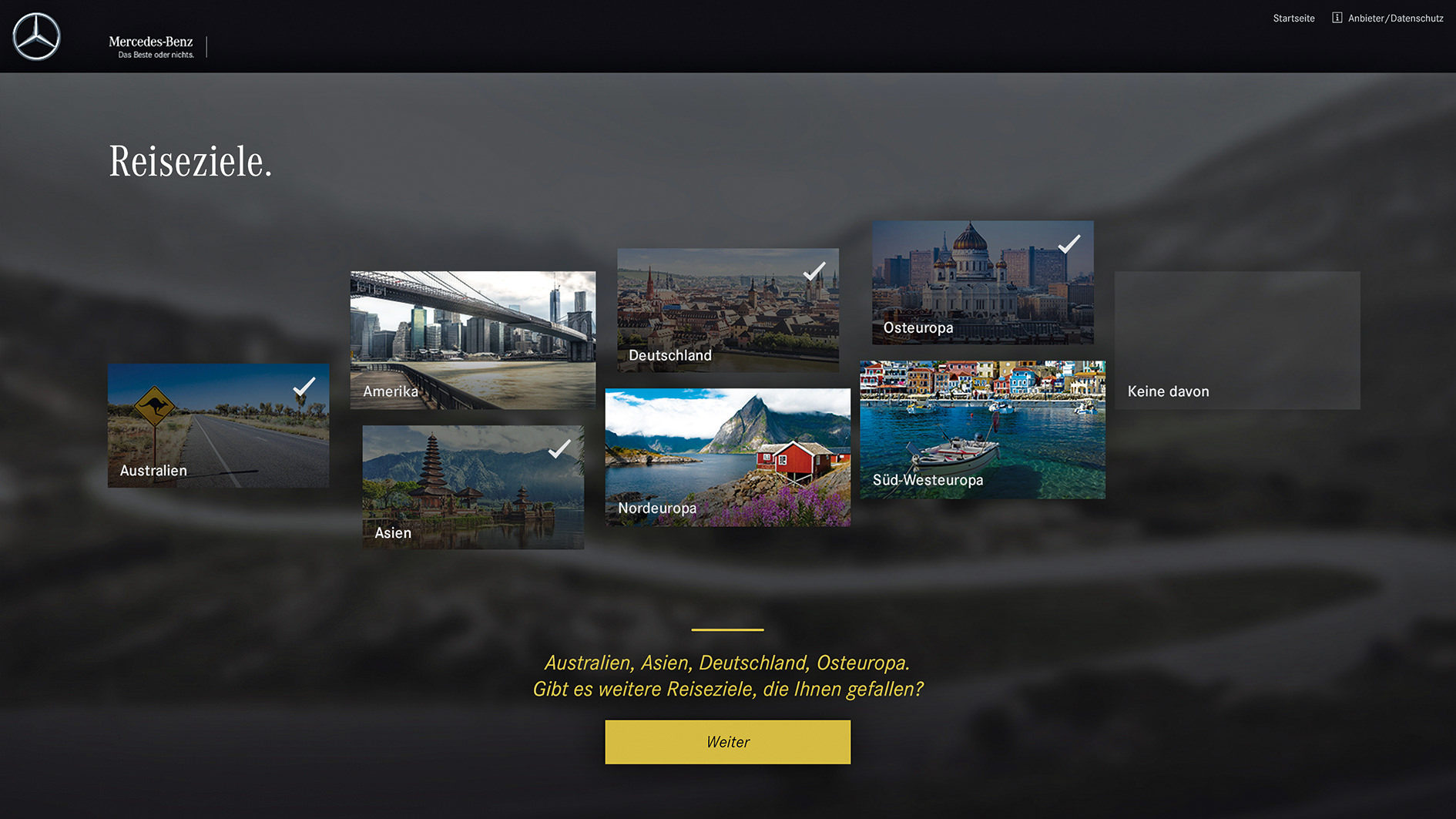
The Mercedes-Benz Lifestyle Configurator, which earned a Red Dot Design Award, offers a prime example of how the configuration experience can start from the customer’s world — not from the product’s technical specifications.
Instead of beginning with engine types or trim levels, the journey starts with simple but powerful questions about the user’s lifestyle: musical tastes, favorite travel destinations, cultural interests.
This data is processed through an intelligent recommendation engine, which then suggests tailored vehicle configurations and accessories that align with the user’s personality and preferences.
The result is an experience that feels intuitive and emotionally engaging — one where the brand is perceived as truly understanding and accompanying the customer, rather than simply offering a product.
The approach reflects a broader trend: configuration is becoming a dialogue, not a transaction. It is about helping customers imagine how the product will fit into their life, rather than simply guiding them through a set of choices.
Porsche: building configurators powered by realtime CGI
Porsche has taken a different but equally inspiring path — pushing the limits of visual quality and immersive experience in digital configuration.
The new Porsche Car Configurator allows users to explore more than one billion combinations in real time, powered by advanced realtime CGI technology that delivers photorealistic 3D rendering of the highest quality.
This technology choice is key: using realtime CGI enables every configuration to be represented with a level of detail and consistency that static pre-rendered images simply cannot match.
Every material, finish, proportion, and subtle design element is faithfully reproduced — giving users an experience that is not only highly immersive, but also fully aligned with the actual product.
Once again, the configurator is no longer just an interface — it becomes a true digital extension of the brand’s creative and engineering DNA.
This is a vision we deeply share at In2real: we have been working for years with realtime CGI pipelines, developing advanced configurators that allow our clients — across automotive, design, and beyond — to deliver visual experiences of the highest standard.
images by Porsche
The numbers behind the value
This is not just about creating “nice-to-have” features — the numbers clearly show the business impact.
Configurators with interactive 3D visualization see a 40% increase in average time spent on site – Forrester Research.
When AI and personalized storytelling are integrated, conversion rates for qualified leads rise by 25-35% – Capgemini.
Perhaps most telling of all, customer satisfaction rates exceed 90% for next-gen configurators, compared to under 70% for traditional static ones – McKinsey.
In short, digital configurators are now central to the customer journey and to how the brand itself is perceived.
From User Expectations to Business Impact: The New Role of Digital Configuration
Today’s customers expect more than seamless functionality — they seek experiences that are immediate, emotionally engaging, and reflective of who they are.
They want to feel understood through the interaction, and they expect the product visualization to be accurate and compelling — with materials, textures, and proportions rendered faithfully. In this context, the ability to integrate high-quality 3D content directly sourced from design and engineering teams is a key factor in delivering an immersive and authentic experience.
To meet these heightened expectations, configurators must evolve on two essential fronts. First, they must elevate visual fidelity through advanced 3D engines that can bring the product to life in real time. Second, they must leverage customer profiling and artificial intelligence to shape dynamic, adaptive journeys — journeys that resonate with the unique lifestyle and preferences of each user.
This is precisely the direction we are pursuing in In2real & Intelligo works. By collecting real behavioral data, designing sophisticated user experiences, and enabling rich, immersive visualization, we transform our digital solution from a static interfaceor datas into a personalized digital narrative experience — one that deepens engagement and reinforces the brand promise.
And the business outcomes are clear. Companies that adopt this approach see leads that are more qualified and engaged, higher conversion rates driven by intelligent cross-selling and up-selling, and lower costs thanks to more efficient sales processes.
Ultimately, the configurator becomes a strategic engine for digital transformation — a space where brand, product, and customer come together in a dialogue that is both human and impactful.
Identify, Match, Connect
How we approach it at In2real, Intelligo, and Auto Match
The cases of Mercedes-Benz and Porsche point to a clear direction: data, engagement, and high-quality visualization are now the key pillars of digital configuration.
This is exactly the path we follow every day.
With Auto Match, we truly put the customer at the center — collecting real data and designing highly engaging and personalized user experiences.
Through our real-time 3D configurator solutions, we help brands shape their customer journey and foster meaningful, lasting relationships.
Our goal? To turn every digital project into an authentic, memorable experience — and into a true strategic driver for brand growth.
If this vision resonates with you, we would love to explore it together. Shall we talk?
Stay connected with the Future!


I believe great communication begins with listening. With a background in design and five years leading In2real’s communication efforts, I work with our team to help brands connect with their audiences through clear strategy, visual quality, and digital storytelling.