AR & Spatial Computing: What Changes When the Goal Goes Beyond Engagement
What Changes When the Goal Goes Beyond Engagement
The Real Question Isn’t Whether AR Can Do This
If you work in marketing or brand for a company with a complex product — a vehicle, an industrial machine, a high-end furniture piece — you’ve probably worked with augmented reality already: a configurator, a try-in-your-space viewer, maybe an AR filter for a campaign. And even phone-based AR already lets you walk around it at real scale, change its color, look at it from every angle. We’ve covered that side of AR — the engagement and brand-connection side — in a previous piece; this one picks up from there.
So the right question isn’t “can AR do this?” — on that, the answer is already yes. The real question is: when that walk-around needs to produce a decision — on design, on configuration, on pricing — what actually changes compared to just showing the product?
There’s a different line to draw, and it runs between showing a product and evaluating it. This isn’t a story about two competing technologies: Apple’s visionOS, the platform built around spatial computing, uses AR technology — world tracking, scene reconstruction, image tracking — as part of how it works. It’s a story of evolution, not replacement — and that’s what this article is about.
What AR Is Good At
Augmented reality has earned its place in marketing for good reason. It lets a customer place a product in their own space — at home, on their body, next to their car — and that sense of closeness has a measurable effect. Research on AR and brand relationships has found that this proximity translates into stronger brand engagement and closer emotional connection with consumers (Rauschnabel et al., Psychology & Marketing, 2024). A more recent meta-analysis, aggregating 111 studies and more than 547,000 participants on AR and VR use in retail, confirms the direction of the effect at a larger scale: experience quality is systematically and positively linked — moderately to strongly (r between 0.40 and 0.70) — to customer attitude, purchase intention and loyalty (Fan et al., Sustainability, 2025).
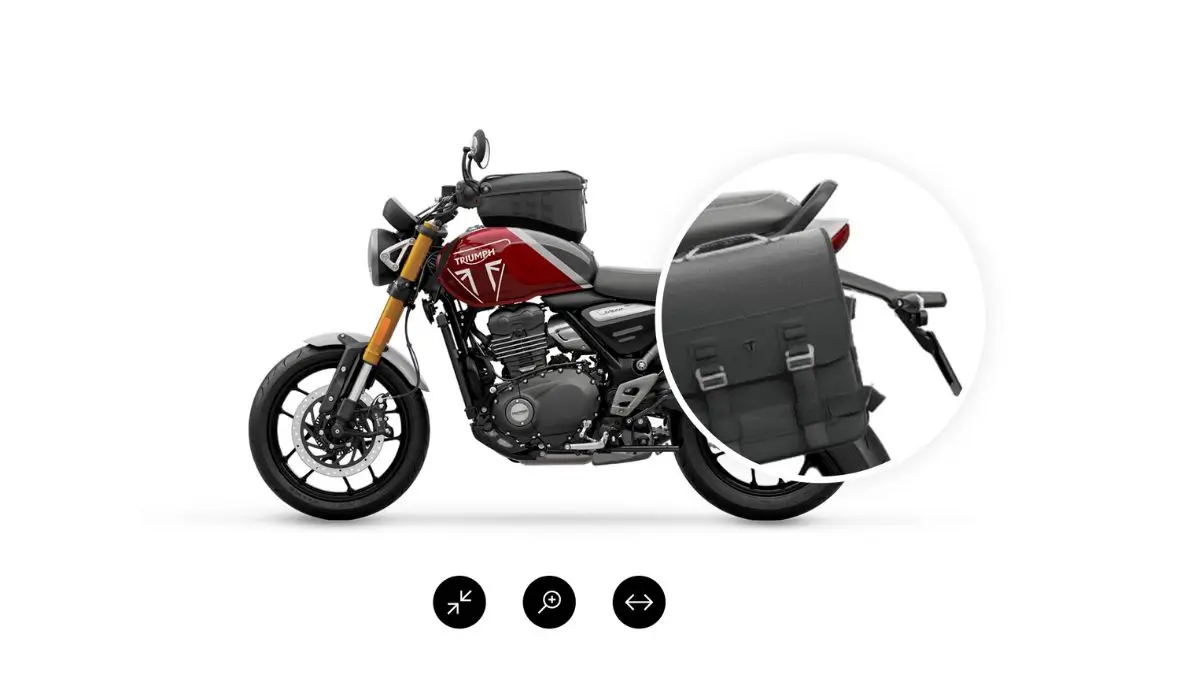
It’s the same principle behind the motorbike 3D configurator: being able to place the model in your own space, rotate it and change its colorway produces a kind of engagement a static image gallery can’t replicate.
The same holds for furniture: seeing a piece in AR, in your own living room, under the room’s real light, before buying, is exactly the kind of proximity the research links to a stronger connection with the brand — the same principle behind the AR product visualization we built for OMP Group.
That’s exactly what AR was designed to produce, and it’s still doing that job well — we’ve looked specifically at how AR drives this kind of engagement in marketing here.
Why We’re Talking About This Now
As long as AR is asked to do one specific job — help someone imagine the product in their own space — a phone is enough, and will keep being enough: it’s accessible, familiar, frictionless. But the more complex the product, the more people reach a point where imagining the product isn’t enough anymore: they need to judge it. Compare one variant against another. Evaluate how a shape reads at real-world scale. Decide, not just get a sense of it.
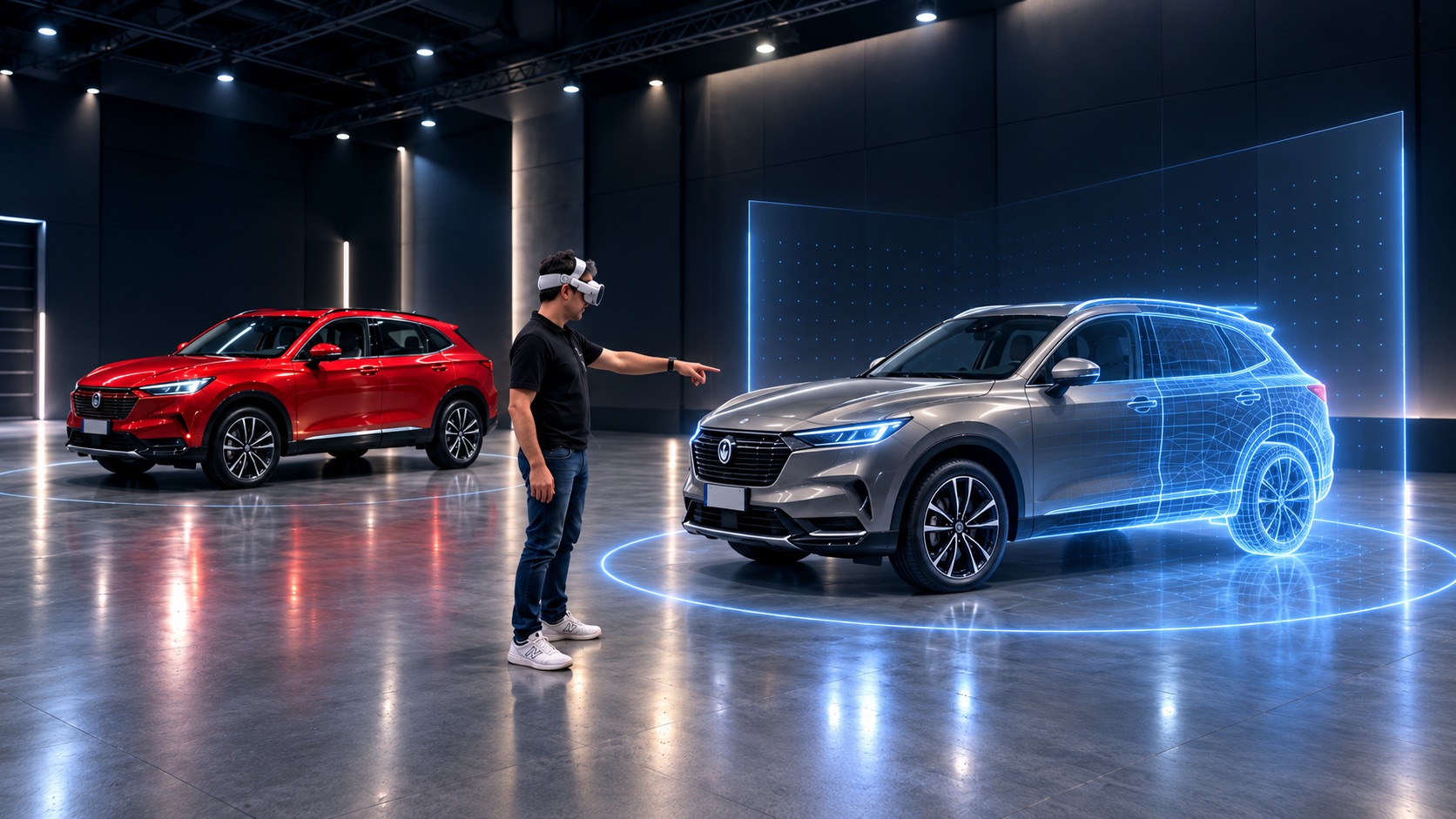
That’s where spatial computing comes in — not as a technical upgrade to AR, but as an answer to a different question. AR answers “can I imagine this product in my world?” well. Spatial computing is built to answer “can I evaluate this product as something occupying my world?” — walking around it, comparing it directly to an alternative, judging its proportions the way you would a physical object in a room.
The Line That Actually Matters
Whether it’s a phone-based AR configurator or a headset, you can already walk around a car at real scale. What separates an experience built to show from one built to evaluate isn’t the technology — it’s what surrounds the experience:
- Fidelity of materials, color and light. A configurator optimized for scroll and a model built to hold up under close scrutiny have different fidelity standards — the second has to survive the eye of someone looking for flaws, not just someone forming an impression.
- Real-scale presence. It’s not enough for the product to be “to scale” on a screen — it has to occupy space the way the physical object would, for someone judging it by walking around it.
- Side-by-side comparison. Evaluating almost always means comparing — one variant against another, one model against a competitor. You need to place them next to each other, under the same conditions.
- Equal conditions for every respondent. If the judgment is meant to count as data, every person needs to see the same stimulus, the same way, under the same lighting and scene conditions.
- Data collection. Showing a product generates engagement. Evaluating it generates a judgment that needs to be captured, structured and made comparable — otherwise it stays an impression, not an input for a decision.
These five elements — not the headset type or the absence of a screen — are what moves an experience from the register of communication into the register of decision.
Why This Matters, Even If Your Job Today Is Showing, Not Evaluating
If your work stops at visualizing the product — a configurator, a campaign, a social experience — AR remains exactly the right tool, and its audience is only getting larger. But the moment someone in your organization needs to start judging instead of just showing — a design director, a research team — it’s worth knowing that’s a different job, with different requirements.
In the next article, we’ll get into that second job: where it fits inside a process that already relies on physical prototypes and clinics, and what actually changes when the walk-around has to hold up a decision.
If you’re weighing whether a project calls for AR, for spatial computing, or for both, the most useful question isn’t which technology to pick — it’s what decision the experience actually needs to support.


A designer by training, I have been working on communications and marketing for In2real since 2019. You can engage with me and my team to identify your company’s needs and define the right strategy.